

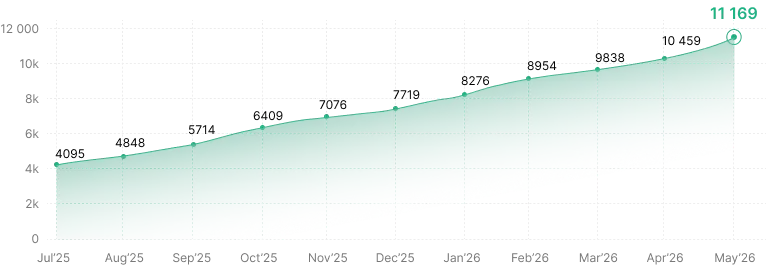
121M+Total Funded
Global investment market worth over $100 trillion
Putting your money to work in assets that can grow over time


How investors accumulate wealth using various asset classes and investment strategies throughout markets worldwide
Global investment market worth over $100 trillion
Average stock market return 7-10% annually long-term
Bonds typically return 3-5% with lower risk
Real estate investments average 8-12% annual returns
P2P lending can offer 6-16% depending on risk

Investors who received at least one interest payment each month.

Rated 4.5 / 5 based on 779 reviews. Showing our 4 & 5 star reviews.
The basic mechanics behind putting your money into assets for returns
Decide where to put your money based on goals, risk tolerance and time horizon
Returns come from price appreciation, interest, dividends or rental income
Check how your investments perform and adjust strategy when needed
Use profits to compound growth or take money out for your goals
Add different investment types to reduce exposure to any single risk
Adjust holdings based on market conditions and personal circumstances
The main reasons investors put money into assets instead of keeping cash under the mattress
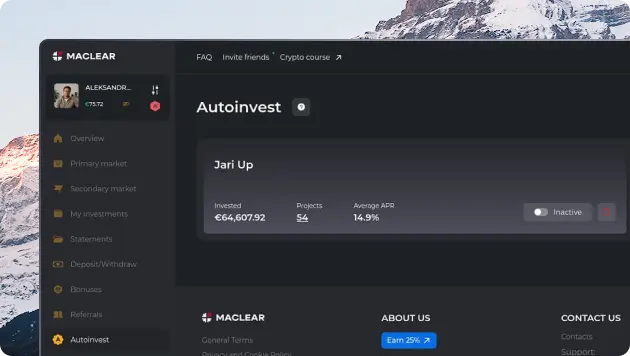
No fees for deposits, investments or withdrawals.
A growing community built around transparent investing.
Average amount invested by active users each month.
Average interest paid to active investors each month.
Vetted projects and borrowers across different risk levels and sectors

Supplies consumer electronics to major retailers and telecomes like Technomarket and Magnum-D

Processes, freezes and dries fruits and vegetables in a modern, fully equipped organic-focused production facility

Supply, installation and maintenance of agricultural and food equipment

Average annual return17.6%
Earned return€460
Promotions€0
Estimated returns based on target rate of 14.6% APY. Actual returns may vary. Past performance does not guarantee future results.
Different asset classes offer varying risk-return profiles for your portfolio
Ownership shares in companies that can grow in value
Loans to governments or companies paying fixed interest
Property investments generating rental income and appreciation
Direct financing of borrowers through crowdlending platforms
Physical assets like gold, oil or agricultural products
Pooled investments managed by professionals for diversification
Exchange-traded funds tracking indices or specific sectors
Art, wine, crypto or other non-traditional investment options
Trade existing investments before maturity if you need liquidity or want to exit a position early
Browse market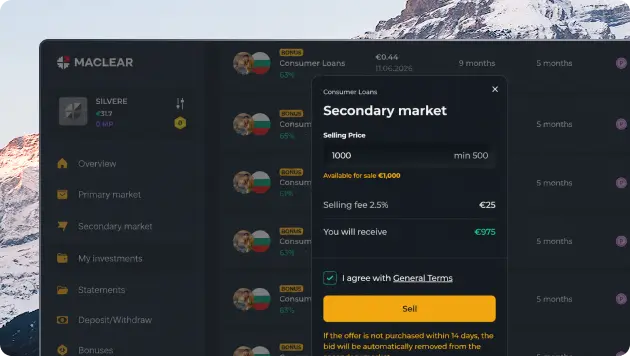
Recognizing the balance between possible investment gains and the chance of losing your original investment amount
Low risk: savings, government bonds (1-3% return)
High risk: stocks, P2P, startups (potential 10%+ or loss)
A simple path from setting goals to building your first portfolio

Time horizon and risk tolerance

Pick investment types that fit

Transfer capital and start building
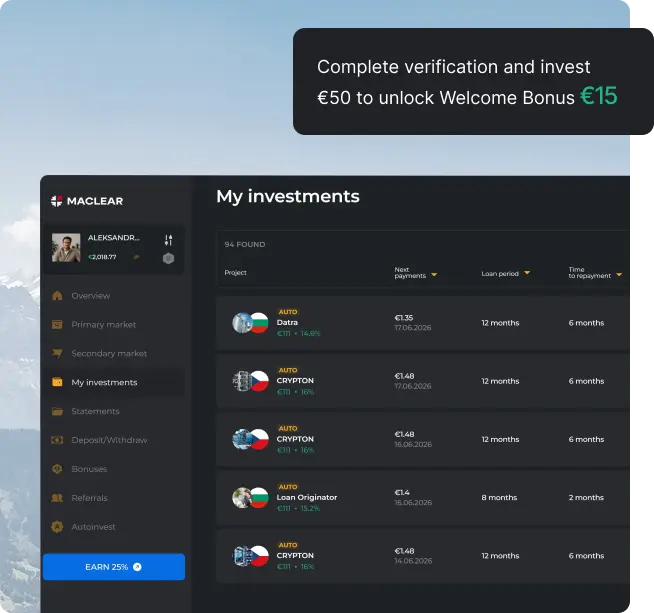

Active investors often get access to better deals, priority allocations and lower fees

See opportunities first

Lower costs over time

Faster help when needed

Better data and analytics

Maclear is a Swiss P2P/B2B crowdlending platform connecting investors with vetted business borrowers and projects. Investments involve borrower default risk, liquidity risk, platform risk and possible loss of capital.


Maclear operates under Swiss law with AML/KYC supervision via PolyReg SRO. We are not a bank and do not lend from our own balance sheet. Investors finance loans by purchasing assigned loan claims — returns are not guaranteed.
 Collateral and the
Provision Fund help reduce certain risks, but do not eliminate investment risk.
Collateral and the
Provision Fund help reduce certain risks, but do not eliminate investment risk.

P2P lending platforms connect investors directly with borrowers, allowing lenders to earn interest on their capital. Returns typically range from 6-16% depending on borrower risk profile and loan term, with investors receiving payments as borrowers repay principal and interest.
Savings keep money in low-yield accounts for security, while investment deploys capital into growth assets like stocks, bonds, or loans. Investments aim to generate returns above inflation rates through price appreciation or income generation over medium to long timeframes.
Spreading capital across different asset classes—stocks, bonds, real estate, and peer-to-peer loans—reduces the impact of poor performance in any single investment. This strategy protects against market downturns while maintaining exposure to varied growth opportunities.
Yes. While cash savings lose purchasing power as inflation rises, investments in stocks (7-10% annual returns), real estate (8-12%), and bonds (3-5%) typically outpace inflation over time. P2P lending at 6-16% can also exceed inflation, preserving and growing wealth.
Investment time horizon determines asset selection and risk tolerance. Longer horizons support higher-volatility growth investments, while shorter timeframes call for stable income-producing assets. P2P platforms serve various horizons through loans ranging from months to years.
Start by defining financial goals, assessing risk tolerance, and building an emergency fund. Begin with diversified positions across accessible asset classes—stocks, bonds, and P2P loans offer varying risk-return profiles. Monitor performance quarterly and adjust allocations as circumstances change.