The Convergence of Index Investing and Markets
Index investing has become the default wealth-building strategy for over 40% of U.S. equity fund assets, according to the Investment Company Institute's 2023 data. Meanwhile, peer-to-peer trading platforms have carved out a parallel niche, offering direct asset exchange between individuals without traditional intermediaries. The intersection of these two domains represents an emerging approach that combines passive investment philosophy with decentralized market mechanics.
Traditional index investing centers on tracking market benchmarks through funds that hold every security in a given index. The S&P 500, for instance, aggregates the 500 largest U.S. companies by market capitalization. Investors who buy an S&P 500 index fund gain proportional exposure to all 500 constituents. This approach has delivered annualized returns of roughly 10% over the past century, making it the cornerstone of retirement accounts and institutional portfolios worldwide.
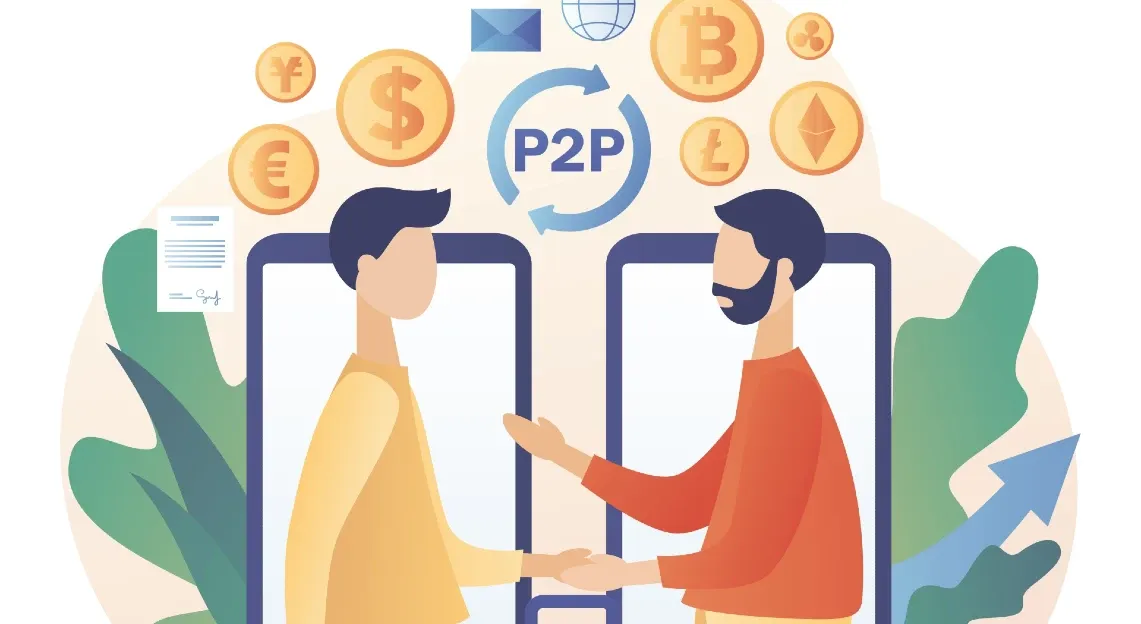
P2P trading platforms, by contrast, facilitate direct transactions between market participants. Whether trading tokenized assets, fractional shares, or basket securities, these platforms eliminate the fund manager as middleman. Users exchange positions directly, often with lower fees and greater transparency than conventional fund structures. The question becomes: can you effectively implement index investing principles in a peer-to-peer environment?
How Index Strategies Translate to Decentralized Platforms
Index investing relies on three core principles: diversification, low turnover, and cost efficiency. Each principle faces unique implementation challenges in P2P environments.
Diversification requires holding a representative sample of an index. An S&P 500 strategy demands positions in 500 distinct securities. On P2P platforms that support tokenized equities or fractional ownership, you can theoretically acquire small stakes in hundreds of companies. Some platforms offer pre-packaged basket tokens that mirror major indices—one token contains proportional claims on all underlying assets. This structure preserves diversification while enabling single-transaction purchases between peers.
Data from blockchain analytics firm Messari shows that tokenized index products held $1.2 billion in assets under management by mid-2023, representing 0.02% of the $6.2 trillion in traditional U.S. index fund assets. The gap highlights both opportunity and nascent adoption. P2P markets currently lack the liquidity depth to support large-scale index implementation, but niche products are gaining traction among retail participants.
Low turnover—the buy-and-hold ethos—transfers naturally to P2P trading. Traditional index funds rebalance quarterly or when index constituents change. Annual turnover rates average 4% for S&P 500 funds. On peer-to-peer platforms, you control rebalancing frequency. You can mirror standard index protocols or adopt a more hands-off approach, trading only when capital allocation drifts beyond target thresholds.
Cost efficiency presents the most significant divergence. Vanguard's S&P 500 ETF charges an expense ratio of 0.03%, or $3 annually per $10,000 invested. P2P platforms typically charge transaction fees rather than ongoing management costs. If you execute 12 rebalancing trades per year at $5 each, your annual cost reaches $60—twenty times the traditional fund expense. The break-even calculation depends on trade frequency, position size, and whether platform fee structures favor larger transactions.
Index Construction on Infrastructure
Building an index portfolio through P2P channels requires deliberate architecture. You face choices about asset selection, weighting methodology, and rebalancing mechanics that fund managers handle automatically in traditional vehicles.
Market capitalization weighting remains the standard. The largest companies receive the largest allocations, matching their share of total market value. As of late 2023, the top ten S&P 500 companies represented 31% of the index. Replicating this concentration on a P2P platform means directing nearly one-third of your capital to ten positions. Some platforms simplify this through synthetic tokens that automatically maintain cap-weighted exposure, adjusting holdings as market values fluctuate.
Equal weighting offers an alternative. Each position receives identical allocation regardless of company size. This approach reduces concentration risk but increases turnover. Smaller companies grow faster than their weights, requiring periodic sales to restore balance. Research from FTSE Russell indicates equal-weighted indices generate 1-2 percentage points of excess return annually over cap-weighted versions, though with higher volatility. Implementation costs matter more in P2P contexts where each rebalancing trade incurs fees.
Factor-based construction has gained prominence among institutional investors. Factors like value, momentum, quality, and low volatility have demonstrated persistent return premiums across decades of data. The Fama-French database documents that value stocks—those trading at low price-to-book ratios—have outperformed growth stocks by 4.8% annually from 1926 through 2023. Factor indices built on P2P platforms let you tilt exposure toward specific characteristics while maintaining broad diversification.
Growth investing intersects with index strategy when you overweight sectors or companies exhibiting above-average earnings expansion. Technology stocks, for instance, delivered 35% returns in 2023 versus 24% for the broader S&P 500. A growth-oriented index approach might allocate 40% to technology rather than the market-cap-weighted 29%. P2P platforms support this customization, though you assume active risk—the possibility of underperforming the benchmark.
Operational Considerations for Index Investors
Transaction execution differs fundamentally from traditional index fund purchases. When you buy a Vanguard fund share, the fund manager has already acquired and holds the underlying securities. On P2P platforms, you must either locate counterparties willing to sell each individual position or purchase a pre-constructed basket token from another user.
Liquidity varies dramatically across P2P markets. Major platforms report daily trading volumes between $10 million and $500 million, compared to $200 billion for the SPDR S&P 500 ETF alone. Limited liquidity creates wider bid-ask spreads—the difference between buying and selling prices. Spreads of 0.5% to 2% are common on P2P platforms, meaning you pay an implicit cost each time you trade. A traditional ETF spread typically runs 0.01% to 0.05%.
Order types matter more in peer-to-peer contexts. Market orders execute immediately at the best available price but may suffer slippage in thin markets. Limit orders specify your maximum purchase price, giving you control but risking non-execution if no counterparty meets your terms. For index investing purposes, where you care about aggregate exposure rather than perfect entry timing, limit orders placed near midpoint prices generally optimize the cost-certainty tradeoff.
Custody arrangements introduce counterparty considerations absent from traditional funds. Established brokerages and fund companies maintain SIPC insurance up to $500,000 per account. P2P platforms vary in their custody models. Some employ regulated third-party custodians. Others use multi-signature smart contracts where assets remain in blockchain-based wallets you control. Neither approach perfectly replicates traditional protections, requiring you to assess platform security, insurance coverage, and legal recourse independently.
Tax treatment can differ between jurisdictions. In the United States, traditional index fund distributions qualify for preferential long-term capital gains rates when you hold shares for over one year. Tokenized assets on P2P platforms may face identical treatment, or tax authorities may classify them as property subject to different rules. The IRS issued guidance in 2019 stating that each cryptocurrency trade constitutes a taxable event. If your P2P index strategy involves frequent token swaps, you could trigger short-term gains taxed at ordinary income rates reaching 37%.
Performance Benchmarking and Tracking Error
Index investing success hinges on minimizing tracking error—the deviation between your portfolio returns and the benchmark index. Traditional funds report tracking error below 0.10% annually. P2P implementations face structural challenges that inflate this metric.
Rebalancing frequency drives tracking error in two directions. Too-frequent trades maintain closer index alignment but increase transaction costs. Too-sparse rebalancing allows positions to drift as market values change. Academic research published in the Journal of Portfolio Management finds that quarterly rebalancing optimizes the tradeoff for most retail investors, producing tracking error under 0.50% while containing costs below 0.20% annually.
Dividend reinvestment requires explicit attention on P2P platforms. Traditional index funds automatically reinvest distributions, purchasing additional shares immediately. When you hold individual positions through peer-to-peer channels, dividends may arrive as cash requiring manual reinvestment. The cash drag—holding uninvested capital while arranging trades—can reduce annual returns by 0.15% to 0.30% for indices yielding 1.5% to 2.0%.
Benchmark selection sets your performance standard. The S&P 500 remains the most-cited U.S. equity benchmark, but alternatives like the Russell 3000, Wilshire 5000, or MSCI World offer broader coverage. If you construct a P2P index portfolio tracking the S&P 500 but compare results to the Russell 3000, apparent underperformance may simply reflect small-cap exposure differences. Data providers like MSCI and FTSE Russell publish daily index values and constituent lists, giving you transparent benchmarks for performance evaluation.
Risk Management in Decentralized Index Strategies
Index investing reduces individual security risk through diversification, but P2P implementation introduces platform-specific exposures. Maclear offers tools to help navigate these unique considerations.
Smart contract risk affects blockchain-based platforms. If a coding error allows unauthorized token creation or transfer, index tokens could lose value regardless of underlying asset performance. The industry has experienced high-profile failures: a $600 million Poly Network hack in 2021 exploited cross-chain messaging bugs, and a $320 million Wormhole bridge attack in 2022 targeted validation logic. Platforms with extensive security audits, bug bounties, and insurance funds mitigate but do not eliminate this risk.
Regulatory uncertainty clouds long-term viability. Securities regulators worldwide continue debating whether tokenized index products constitute securities requiring registration. The SEC's 2023 actions against multiple cryptocurrency platforms alleged unregistered securities offerings. If regulators mandate compliance costs that P2P platforms cannot sustain, users may face forced liquidations or asset migrations. Geographic diversification across platforms in multiple jurisdictions spreads regulatory risk.
Concentration risk remains relevant even in diversified indices. The S&P 500's top-heavy construction means ten companies drive 31% of returns. Technology sector weight reached 29% by year-end 2023, up from 20% in 2019. If you implement this concentration through P2P channels, you inherit the same sector and stock-specific volatility as traditional index investors. The 2000-2002 technology crash erased 78% of Nasdaq value, demonstrating how sector concentration amplifies drawdowns.
Operational risk encompasses platform outages, erroneous trades, and settlement failures. Traditional brokerages offer error correction mechanisms and regulatory safeguards. P2P platforms may lack similar protections. Blockchain transactions are generally irreversible—if you send tokens to the wrong address, recovery depends on recipient cooperation. Some platforms incorporate escrow mechanisms or dispute resolution processes, but standards remain inconsistent across the industry.
Cost-Benefit Analysis for Different Investor Profiles
Index investing through P2P platforms makes sense for specific use cases while remaining suboptimal for others.
Small-balance investors face high proportional costs. If you hold $1,000 and pay $5 per trade, each transaction consumes 0.5% of capital. Quarterly rebalancing across ten positions costs $200 annually—a 20% expense ratio. Traditional index funds charging 0.03% to 0.20% deliver superior economics until account size reaches approximately $50,000, where P2P transaction costs fall below 0.20% annually.
International investors encounter different calculations. Cross-border fund access involves currency conversion, foreign transaction fees, and potential withholding taxes. If you live in a jurisdiction with limited traditional index fund availability, P2P platforms may provide your only practical access to diversified U.S. or global equity exposure. Transaction costs become secondary to market access.
Privacy-focused users value pseudonymous trading. Traditional brokerages require extensive personal identification, income documentation, and transaction reporting. Some P2P platforms allow trading with minimal identity disclosure, though anti-money-laundering regulations increasingly mandate KYC procedures. The privacy premium depends on your jurisdiction and personal priorities.
Index investors seeking customization benefit most clearly. Traditional funds offer fixed asset lists and weighting schemes. On P2P platforms, you can construct bespoke indices excluding specific sectors, overweighting particular factors, or incorporating environmental, social, and governance screens. This flexibility commands a cost premium but delivers portfolios precisely aligned with your preferences. Exploring alternative investment through P2P trading can reveal additional customization opportunities.
The Future Landscape of Decentralized Index Products
Platform evolution will determine whether P2P index investing transitions from niche experimentation to mainstream adoption.
Liquidity aggregation stands as the critical development. Current platforms operate as isolated pools. Emerging protocols like the Inter-Blockchain Communication standard enable token transfers across networks, theoretically consolidating liquidity. If a user on Platform A can seamlessly trade with a user on Platform B, combined liquidity approaches levels that support efficient index implementation. Cross-platform trading volume exceeded $10 billion monthly by late 2023, up from $2 billion in early 2022.
Automated rebalancing through smart contracts could eliminate manual trade execution. You might deposit capital into a contract programmed to maintain S&P 500 weights. The contract automatically executes trades as market values shift, deducting transaction fees from your balance. This approach replicates traditional fund mechanics while preserving P2P structure. Several platforms launched such products in 2023, though assets under management remain under $100 million each.
Regulatory clarity will expand or contract possibilities. Favorable rulings that classify index tokens as commodity-like instruments could attract institutional capital and reduce compliance costs. Adverse decisions requiring securities registration would impose burdens potentially exceeding traditional fund expenses. The direction remains uncertain as of early 2024, with parallel enforcement actions and legislative proposals moving through multiple jurisdictions.
Traditional financial institutions are testing hybrid models. Fidelity, Charles Schwab, and BNY Mellon have all initiated blockchain asset custody or tokenization pilot programs. If established firms launch P2P index products backed by their infrastructure and insurance, the risk-cost calculation shifts dramatically. Users could access peer-to-peer trading benefits with traditional protections—potentially the optimal combination for index investors. Understanding how does crowdfunding work provides insights into similar decentralized funding mechanisms.
Making the Index- Decision
Your choice between traditional index funds and P2P implementations depends on quantifiable factors: account size, trading frequency, access constraints, and cost tolerance.
Calculate your break-even threshold. List all costs for both approaches: expense ratios, transaction fees, spread costs, custody fees, and tax implications. If traditional index funds cost $50 annually and P2P approaches cost $300, you need $250 of additional value—whether through customization, access, privacy, or other benefits—to justify the premium.
Assess your technical capability honestly. P2P platforms demand higher user competence than traditional brokerages. You must understand blockchain addresses, private key security, smart contract interactions, and platform-specific interfaces. Mistakes carry permanent consequences. If you lack confidence managing these details, the stress and error risk outweigh potential benefits.
Consider your time horizon. Index investing works through decade-long compounding. If platform uncertainty or regulatory risk might force portfolio liquidation within five years, you sacrifice the strategy's core advantage. Traditional vehicles offer greater stability for true long term investment positions.
Start with a test allocation. Before committing your entire index portfolio to P2P platforms, allocate 5% to 10% while maintaining core holdings in traditional funds. Monitor tracking error, costs, and operational friction over at least one full market cycle. This empirical approach reveals whether theoretical advantages materialize in your specific circumstances. Reviewing the best investment platforms can help you identify suitable options for both traditional and P2P approaches.
